
Make a Water Drop Microscope
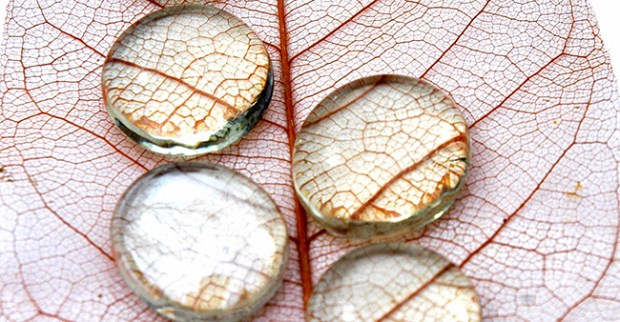
With just a few common items from around the house, you can make a simple microscope that’s straight out of history.
Click here for a PDF version of these instructions.
WHAT YOU’LL NEED
- Paper punch
- Thin piece of cardboard (a postcard or file card)
- Aluminum foil
- Needle
- Toothpick
- Petroleum jelly
- Glue
- Eyedropper
- Distilled water
- Scissors
- Flashlight or other light source
WHAT YOU’LL DO
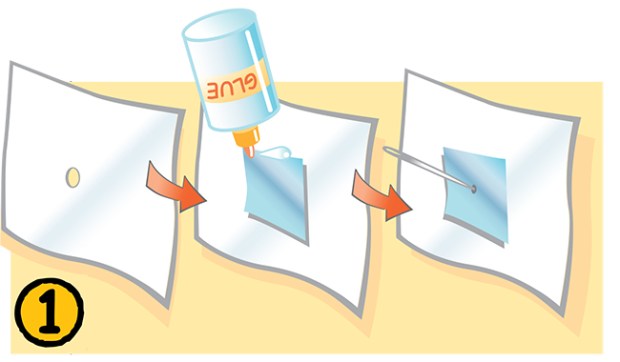
Step 1: Punch a quarter-inch hole in the cardboard. Cut and glue a piece of foil on the card to cover the hole. Do not get any glue over the hole. Gently poke the needle through the foil. Make the pinhole round and smooth; the more round the hole, the better your microscope will work.

Step 2: With the tip of a toothpick, carefully spread a thin layer of petroleum jelly just around the hole on both sides of the foil. Make sure to keep the hole open, free of jelly. With an eyedropper, squeeze a drop of clean distilled water into the pinhole. The petroleum jelly should hold the water in the pinhole. You may have to tap the card gently to get the water in the hole.
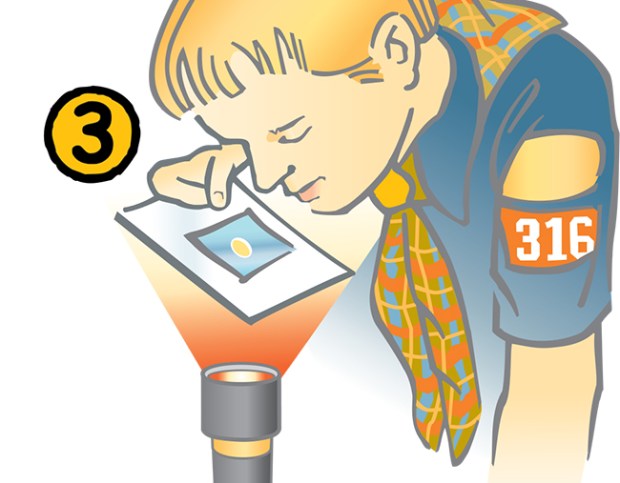
Step 3: Point the flashlight upward. Place the object you want to study over the light. Look at the object through the water drop.
You can study many things around the house. Onion skin, salt, sugar, a strand of human hair, the tip of a pencil and insect parts are good. Ask to borrow a few prepared slides from your science or biology teacher.
ABOUT YOUR MICROSCOPE
Your homemade microscope is much like the first magnifying devices two Dutch inventors created.
Zacharias Janssen made some of the first eyeglasses in the 1500’s and is credited with inventing the first compound microscope around 1590. Anton van Leeuwenhoek later created microscopes in the 1600’s that could magnify objects more than 270 times.
Leeuwenhoek called the tiny objects he saw “invisible animals,” which later became known as bacteria. He studied other life forms, such as mites, lice and fleas. His
findings led him to inspect with his microscope the blood of fish, birds, tadpoles, mammals and humans. He was the first to identify red blood cells.
It was blurry and did not work well at all. I wish it did; I was very excited!
I got to see some algae cells with this.
does not work
It’s just a weird blurry mess. I was actually exited😔
I tried it and it did not work at all, all I could see was a blurry mess. I do not recommend it.
do we have to use distilled water, can we use tap water?
this project was grate for me and it also works to
I tried it but it didn’t seem to work
I made on for the science fair in the mid 60’s and won. Mine was made of metal with small hole and a drop of water and worked great
excellent !!!!!!!!!!
🙂
Thanks a lot
How does this work ? I’m doing a project and I need to know how it works
It is easy the water is a lens so all you have to do is put a drop of water in mid air
um i dont think it works it dosnt have the rite tecnolagy but i will try it becaes it looks cool
It works you just won’t be able to see at a very high magnification actually I think its technically more of a magnifying glass.
COOL PUT A VIDEO OF THE DIRECTIONS AND A VIDEO OF IT WORKING THANKS
I love sience in fact I maybe a sientist when I grow up.
My class once made a microscope but it was slightly different. 😉
wow
I have a real microscope at home.It sees cells,but not much though.
i dont think it will work
it works because of water refraction!
i need to do that 😮 🙂
It probibly dos’nt see cells just small detals.
for me i took a video of some algae it can see cells based on how small the hole is
You can just take a microscope slide and put a drop of tap water on it.
IT REALLY WORKS!!!!!!!
the scop was able to see cells
Of course it does!!!!!!!!!!!
Does it really work?
By using it can we see a cell?
this will be cool it will probly be expensive for distilled water though
it’s not that expensive its not even but 3 or 4 dollars for
a gallon at walmart
that’s so primitive, it’s cool
SOOOOOOOOOO COOOOOOOOOOOOOOOL
this going to be cool
Cool scope!!!!!!!!!!!!!!!!!!!!!!!!!!!!!!!!!!!!!!!!!!!!!!!!!!!!!
I like your hobbies you hav on this website!!!!!
Does it can see a cell?