
How to Make a Fast Pinewood Derby Car
Packs nationwide are gearing up for their annual Pinewood Derby. There are a variety of ways to make your Pinewood Derby car go faster. Explore the following tips to optimize your car’s performance and gain a competitive edge in an upcoming race.
BASIC GUIDELINES FOR PINEWOOD DERBY CAR DESIGN
The possibilities are endless when it comes to picking a shape for your Pinewood Derby car. Before you begin, consider the following general guidelines:
Avoid Pointed Noses: A pointed nose will make it difficult for your Pinewood Derby car to rest on the pin at the starting gate. It may also cause your Pinewood Derby car to get bumped around when the pin drops, and it can create problems for electronic timing systems at the finish line.
Weight Distribution: Leave ample wood in the rear of the Pinewood Derby car so you can place additional weight there. Concentrate the majority of the weight in the rear for optimal performance.
Maximum Weight: Aim for the maximum allowable weight, typically limited to 5 ounces in most races. If your car falls short of this weight, strategically add coins or other weights to meet the requirement.
Clarity in Orientation: Clearly distinguish the front and back of your Pinewood Derby car. In many races, the race officials — not you — will actually place each Pinewood Derby car on the track. Sometimes the officials put the Pinewood Derby car on the track backward because they can’t tell which end is which.
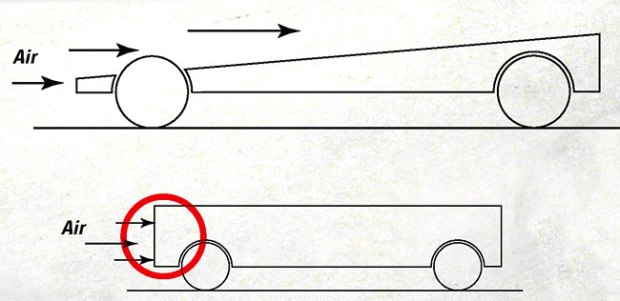
Aerodynamic Design: Select a design that facilitates smooth airflow over and around the Pinewood Derby car body. Pinewood Derby cars with aerodynamic profiles go faster.
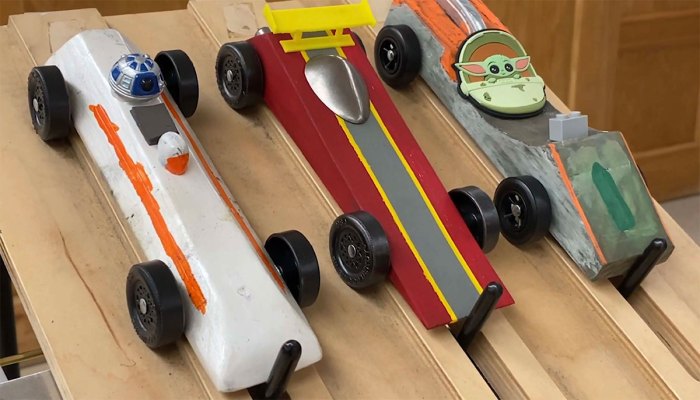
See photo galleries of hundreds of Pinewood Derby car designs.
10 STEPS FOR DESIGNING AND BUILDING YOUR PINEWOOD DERBY CAR
You don’t have to strive for the fastest Pinewood Derby car to have fun competing in your Pinewood Derby. But if you and a helpful adult are willing to put in the extra time and effort, these tips are for you.
1. Bake the Block: Start your Pinewood Derby car project by baking the wood block at 250 degrees for two hours. This removes moisture and lightens the block, allowing you to place more weight at the rear of the car where you actually want it.
2. Crafting the Design: Outline your Pinewood Derby car on paper, cut it out, and affix it to the wood block.
Remember, a rectangular car is not an aerodynamic design. The most basic aerodynamic design is a simple wedge. If you don’t have time to design a complex car, a wedge will work just fine.
Download a Pinewood Derby car template PDF to help you create your design.
3. Rough Cut the Design: Use a coping saw or enlist the help of a responsible adult with a power tool to cut out the rough shape of your Pinewood Derby car.
4. Shape Your Car: Smooth edges and shape your car using sandpaper. An adult can assist with a rotary tool or other shaping tools.
5. Sand and Paint Creatively: Reduce friction by smoothing the car’s surface and paint an awesome design to make it look great.
How to paint your Pinewood Derby car to give it a shiny finish.
6. Axles and Wheels Alignment: Make sure they are aligned perfectly straight. You can test the alignment of your axles by pushing your car across a smooth floor or table. It should roll smoothly in a straight line.
— Consider a Three-Wheeler: Raise one wheel about 1/16 inch higher so it never actually touches the track. Less friction = more speed. Rules vary from pack to pack, so make sure to check your pack’s Pinewood Derby rules to make sure three wheelers are allowed in your race.
— Extend the Wheelbase: Maximize the distance between front and rear wheels. Again, make sure this is allowed in your race.
Learn about polishing Pinewood Derby axles and wheels to reduce friction.
7. Secure Axles with Glue: Glue the axles firmly in their holes to ensure that they stay perfectly placed, but make sure you don’t get glue on your wheels.
8. Strategic Weight Addition: Remember to make your Pinewood Derby car as heavy as the rules allow. In general, it’s best to place weight to the rear of your car because a heavier rear increases speed.
Learn scientific Pinewood Derby speed tips from a former NASA engineer.
9. Use Graphite: Add graphite or another dry lubricant to reduce friction. The less friction between the body and wheel, the better.
10. Have fun! And finally, remember the most important rule of a Pinewood Derby is that it’s supposed to be fun. While you should always strive to do your best, don’t get caught up in winning or having the fastest car. Just enjoy the ride.
Adapted from the book “Pinewood Derby Speed Secrets,” DK Publishing, $12.95 softcover.
thank you this was very helpful and the info on the video helped me learn about the pinewood derby again thanks!xoxo
Very cool and fun pinewood derby
this is raele gate to halp me win
This artiucle helped me and my not so helpful team win a school science contest. Thank you !!!!!!!~!!!!!!! Sincerely, Person from New Jersey.
I think your article was informational and really helps people when it comes to build a car.
So sad I can’t compete this year!
download pokemon and animal crossing
Most IMPORTANT, HAVE FUN!!
These tips are great but in most cases entries must have all four wheels touching the track. There are also some restrictions on how wide the wheel base can be so make sure you know the rules of the race before you make alterations.
Thanks!
Great tips guys!
Pinewood derby is a great way to teach cubs about physics. Basically the car body represents stored energy. One trick to speeding up a car is to remove mass from the wheels so that less energy is required to start and keep the wheels turning. Less mass in the wheels also allows more weight to be added to the body.
Doing good guys doing good
thanks
cool
awesome
fun
Also make sure that you also smooth down any plastic burs on the wheels but make sure you do not create any flat spots while doing so.