
How to Treat Your Water to Stay Healthy in the Backcountry
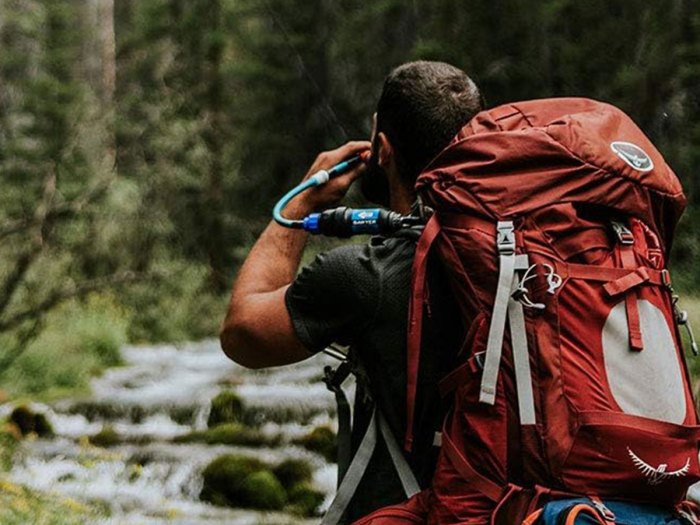
Sickness-causing microorganisms in the water, called “pathogens,” are top reasons hikers bail on a big trip, says Chris Casserly with Outdoor Gear Exchange, an outdoor sports store in Burlington, Vermont. Casserly has conquered New Hampshire’s 4,000-foot peaks in both summer and winter, and has been camping and backpacking in the Northeast for the last 15 years.
“Take water treatment seriously,” Casserly says. “Getting sick on the trails is no fun.”
Getting diarrhea on the trail is one thing, but some illnesses can linger for months. Most nasty pathogens come from animal poop in the water.
In North America, these nasties include parasites, protozoa and bacteria, like giardia, cryptosporidium, e-coli and salmonella.
HOW TO TREAT WATER
Treat all your water, including melted snow. Don’t assume water is clean, even if it looks clear. Choose your water source carefully. Running water is the best, and a murky puddle is the worst, Casserly says.
Fill your bottle from the middle of the source. Skim the surface with your hand to remove insects, leaves and other floaters. Keep particles down by not disturbing the water as you’re filling up. A rainstorm also stirs up particles in a water source, so avoid gathering water right after a storm.
Runoff is often the dirtiest water. If the water you plan to filter and drink isn’t clear, use a prefilter. Prefilters are available for many water filters.
Boiling water also kills waterborne bad guys. Boil water for one minute at sea level, or for three minutes when you’re above 6,500 feet.
Use hand sanitizer after you treat your water. If you get untreated water on your hands, your hands are now dirty. Keep track of dirty and clean bottles, too. If you fill a dirty water bottle with clean water, the water is dirty and needs to be treated again.
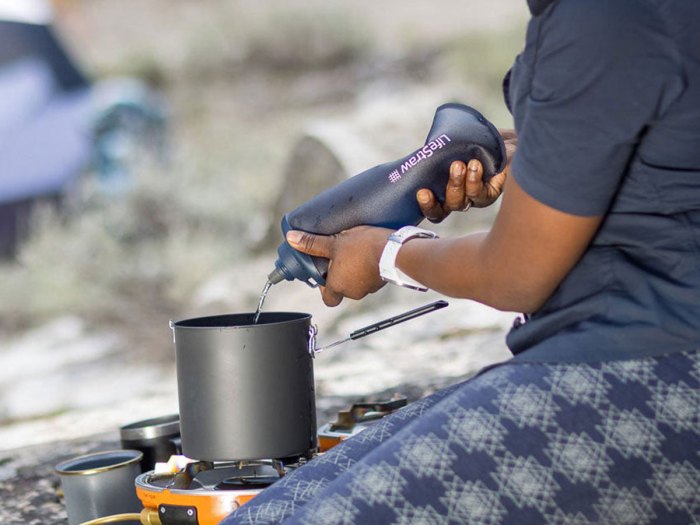
Take good care of your gear. Don’t drop your filter. The impact can crack the filter fibers, preventing water flow.
“Before you hit the trail, test your filter on a bottle filled from your kitchen tap,” Casserly says. “If it’s not flowing or has major leaks, troubleshoot the issue with the manufacturer’s help, or bring the filter to your local shop. If your filter is leaking from the side or if the water isn’t flowing, it might be time to replace your filter cartridge.”
Clean and dry your water treatment gear after you get home from a trip. Most filters come with a backflush option. Backflush your filter with clean water and dry it before you store it.
CHEMICAL TREATMENT
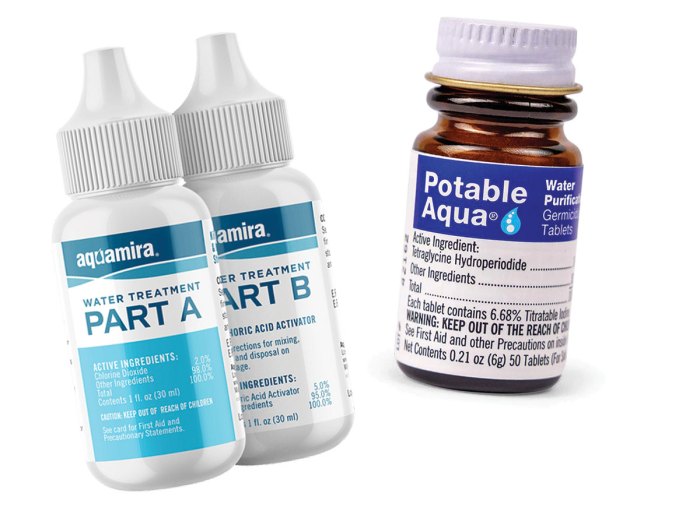
The cheapest and easiest way to kill pathogens in your water is a chemical treatment. You can use iodine or chlorine dioxide, which come in tablets or a liquid added directly to your bottle. Effective brands are POTABLE AQUA ($10 for 50 tablets, pharmacalway.com) or AQUAMIRA ($15 for a 1 oz. bottle, aquamira.com).
Chemical treatments are compact, light and can work in as little as 30 minutes. However, they don’t filter matter from your water, so if your water is cloudy, you should prefilter it.
SQUEEZE FILTERS
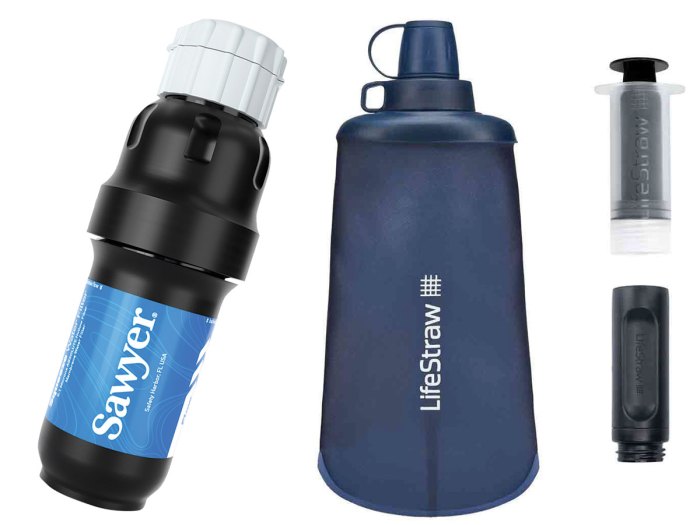
Casserly’s favorite water treatment is a squeeze filter like the SAWYER SQUEEZE filtration system ($29, sawyer.com), which screws onto the included flasks or a plastic water bottle. Squeeze filters are ideal for individual use. They’re light and inexpensive, and you can drink the water immediately through the filter.
Another top choice is LIFESTRAW’S PEAK SERIES COLLAPSIBLE SQUEEZE 650 ML BOTTLE WITH FILTER ($38, lifestraw.com), which has a sturdy flask with a filter inside, capable of lasting up to 2,000 liters.
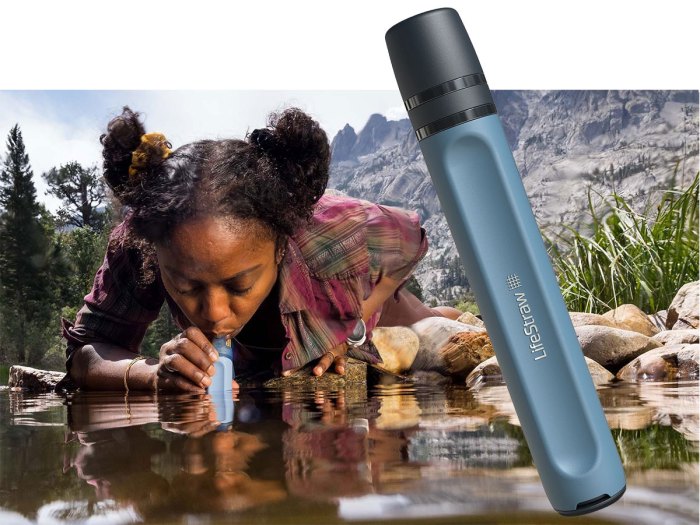
STRAW FILTERS
There’s also the LIFESTRAW PEAK SERIES STRAW ($25, lifestraw.com). Not only does it allow you to drink from the source, but you can also attach it at the end of a hydration hose, screw it onto a standard narrow mouth plastic water bottle or connect it to a gravity filter. But you can’t use it at the water source to easily fill other bottles. Still, it’s a good, light (2.3 oz.) option when you’re backpacking trails with a lot of water along the way.
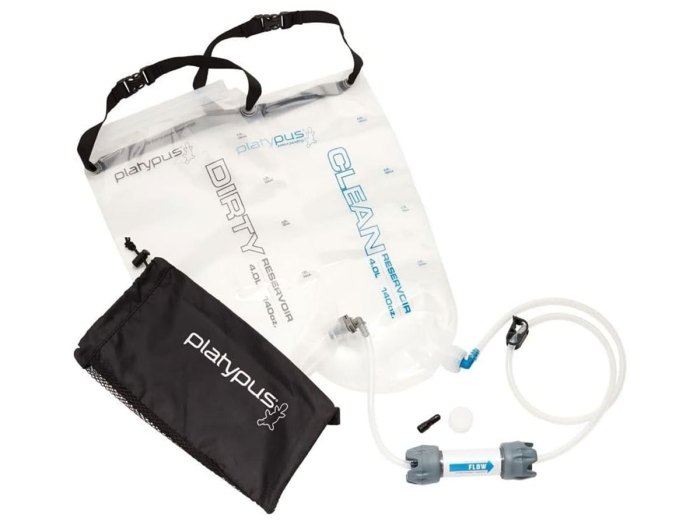
GRAVITY FILTERS
To filter water for big groups, get a gravity filter. PLATYPUS GRAVITYWORKS ($126 for the 2-liter version, $150 for 6 liters, platy.com) is a hanging system with two bags connected by a hose with an inline filter. Using gravity, water flows from the dirty water bag to the clean, filtered one.
Gravity systems clean large amounts of water and some can filter around 1,500 liters before the filter needs to be replaced.
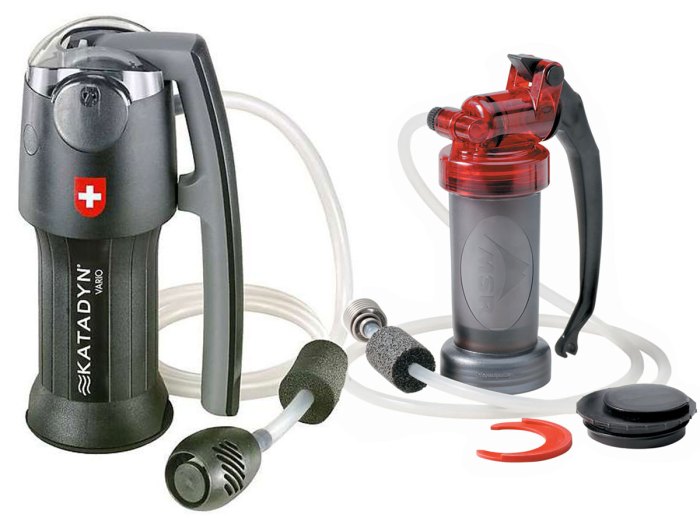
PUMP FILTERS
Pump filters are best for filtering cloudy water. Most have a prefilter to screen out sediment, which can clog a squeeze filter quickly. Pumps are pricey and heavier, but they’re reliable. Most have a carbon filter that makes water taste better, like the MSR MINIWORKS EX MICROFILTER ($120, msrgear.com) and the KATADYN VARIO FILTER ($120, katadyngroup.com).
If you pack a pump, bring a backup chemical treatment just in case.
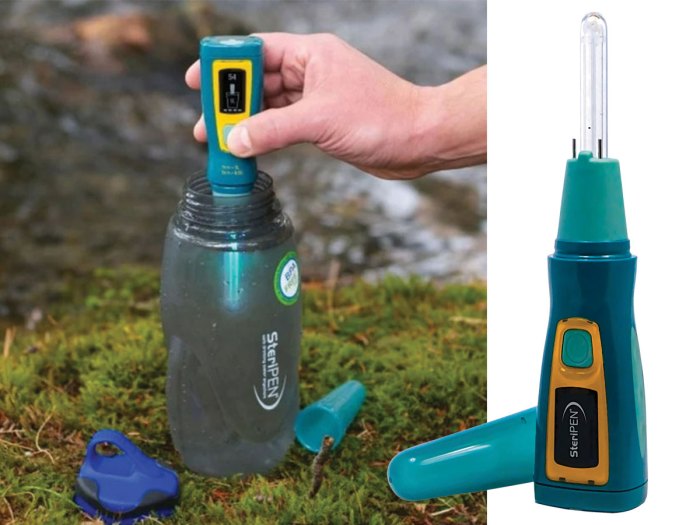
UV PURIFIERS
To eliminate viruses in the water, you’ll need a purifier, not just a filter. Viruses are smaller than bacteria, and a filter can’t trap them. Chemical treatments can kill viruses, and so does ultraviolet light, which KATADYN’S STERIPEN ULTRA UV WATER PURIFIER ($130, katadyngroup.com) uses.
With an ultraviolet light purifier, place the tip of the purifier in a liter of water and stir for about 90 seconds. Ultraviolet purification works best in sediment-free water, but its advantage comes in cold weather. In winter, pumps and filters can freeze, but an ultraviolet light purifier won’t.
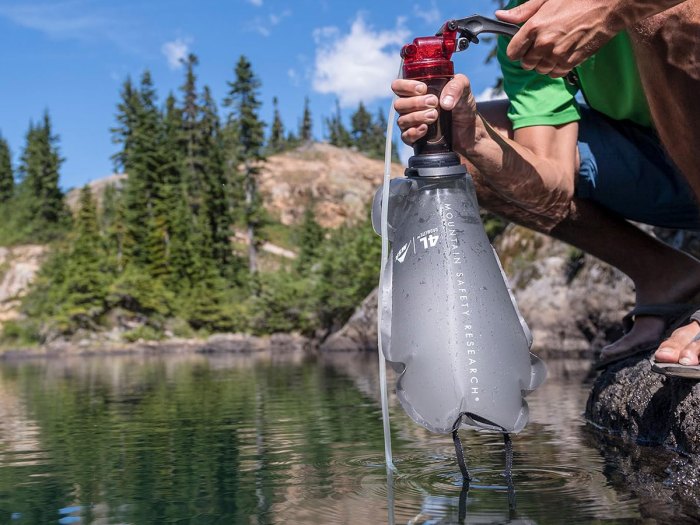
WATER TREATMENT GLOSSARY
WATER FILTERS use microscopic pores to strain out nasty stuff like bacteria from water sources. For most backcountry trips in the U.S., you don’t need more than a filter.
PRE-FILTERS are used to remove large, visible particles before you start the filtering process — particularly important in cloudy water.
WATER PURIFIERS eliminate bacteria, too, but also use chemicals or ultraviolet light to kill viruses, which are too tiny for most filters to remove. Purifiers become more necessary in the deep backcountry or while traveling to some other countries.
yeah.. i think that’s how to filter water but it said that it purifise some type of viruses so does it purify the covid-19 and animal liquid/urine/pee
date: 6/18/2020 4:31 PM
my favorite filter is the Life Straw the reason It Is my favirite filter is that it is easiest method I have used compared with having to make a fire and bowiling the water a
Odd that the single most common filter seen on the trail, the Sawyer Squeeze series, is not mentioned.
Also, the UV option works best if you filter the water first. The water has to be clear for it to work.
Boil it!
We use the Vario by Katadyn. Works great and attaches right to your bottle top eliminating rim contamination. The prefilter allows the main filter to last times longer than most other brands too.
I agree with the boil it group.
Are you really going to take the time on a hike to stop, build a fire or light a stove, boil water, wait for it to cool, and then get going again? lets see… by now you have wasted about 1-2 hours. just buy Potable Aqua taps and use those. But make sure to get the iodine neutralizers. iodine pills are a lot faster then boiling. and plus who wants to drink warm water? And if you dont like using the taps, then just bite the bullet and fork over the cash to get a good filter. Its way worth the money.
When I was in the military most servicemen carried the MSR Miox purifier. It made both a brine and an electric charge to the water; a double control treatment. It lasted a full tour with one kit and 2 AA batteries. If you want a true tested item, here’s one.
First Need is the only way to go no matter where your going or what conditions you will run into in any country. Very professional results (no viruses) not just for filtering fairly clean streams in the backcountry. The only possible draw-back is that you must keep the unit from freezing.
ha
Just back from a Boundary Waters Wilderness canoe trek; and again the Steri-Pen was a champion. it worked quickly and effortlessly for everyone in the group (7 scouts). We did boil our base camp water but individual bottle use by the scouts was covered by “The Pen.” We had our Katadyn Guide pump with but it never saw day light; water was super clear, even before using a coffee filter as a pre-filter. Only spent $7.00 on batteries for the entire trek, that’s thrifty.
I use potable aqua for water treatment in my compact survival kit. It works great when you have the time.
Sawyer Squeeze Filter is the best out there- clean water in 5 seconds
I agree and their new mini is all you need and it filters 100,000 gallons for $20. So basically you can combine all the other filters listed above and they still won’t come close to doing what the Sawyer Mini does. Why would you buy anything else.
I brought a Sawyer mini-filter to the Boundary Waters Canoe Area this summer. Instead of using the bag they provided, I brought along a “used” 1 liter bottle to fill with lake water and squeeze into my canteen. I was the only one to bring the filter. By the end of the first day, there was a line forming behind me to “borrow” my filter. This filter provided water for all 9 of us for six days. The 1-liter bottle was looking very sad by the end, but held up great.
I use a Boat Of Boulder OUTBACK filtering water bottle. costs about $20 and I haven’t got sick yet so it must work!
I need a filter any recommendations?
MSR or a Bota water bottle
The Kadyden Hiker Pro is a great it pumps fast and Im not sick ( not to be confused with the Hiker filter) I highly recommend this filter.
I go with a Bota water bottle. It has a removable built in filter. And is only 20$. Plus it filters 600 gals before you have to replace it!
just boil it
Are you really going to take the time on a hike to stop, build a fire, boil water, wait for it to cool, and then get going again? just buy Potable Aqua taps and use those. But make sure to get the iodine nutrolziers. iodine pills are a lot faster then boiling. and plus who wants to drink warm water? Cold crick water is the only way to go!
A better rule of thumb for proper hydration when hiking is half your body weight in ounces and if you are over exerting yourself double that!
For our unit, boiling water remains the number one process for purifying water; it’s cheap and easy. When time is of essence, we use the stri-pen for clear water (No, batteries wearing out have never been a problem) & for non-clear water we use the Katadyn guide pump, it’s faster than most others and cost the same for replacing filters. My suggestion is try numerous methods and pick those best for you. Always carry a backup, just in case.
Great tips thanks boys life
I’ve used First Need for years; will screw on standard water bottles/water bags. Has a pre-filter, pumps quite fast, and can be field cleaned(reverse hose and you can backwash filter). It has a small bottle of dye which you put into a pot, pump, and if the water shows any sign of bluish/purple dye, it’s time to change filter. Never had a problem with them, and have had three of them. Newest one is very easy to use and pumps quite fast. Can’t go wrong! Camprdon
sounds really cool how much does it cost and how many gals does it filter?