
How to Choose a Backcountry Communication Device
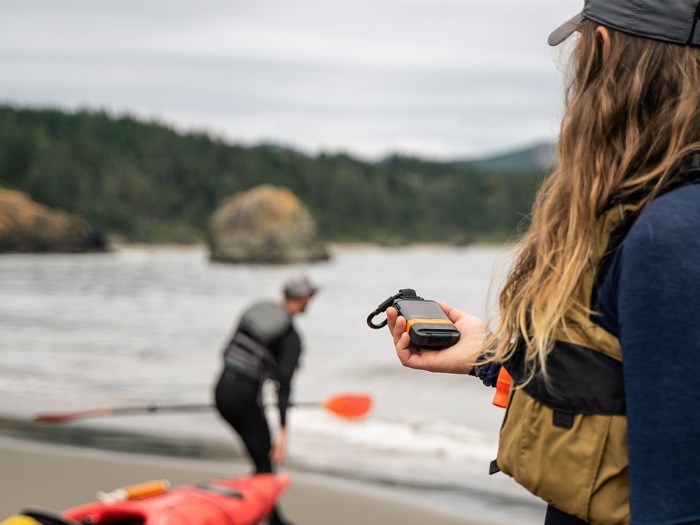
Whether you want to chat with friends on the ski slopes or you need to send a message during an emergency, having a communication device sure comes in handy.
TWO-WAY RADIOS
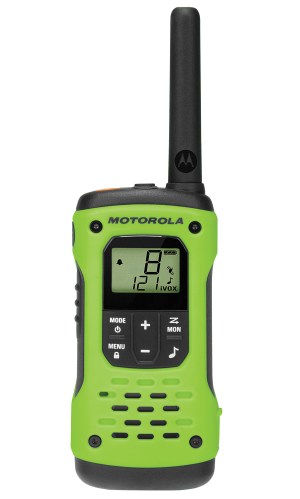 The classic portable walkie-talkies are used primarily for communicating with party members over relatively short distances: While some devices have a range up to 25 miles, terrain and other conditions often limit the signal to a couple of miles.
Look for:
- Ergonomic radios that are easy to use, like when wearing gloves.
- High-powered (1-2 watts) models that provide better reception — even in steep terrain — and better signal quality.
- Radios with a Continuous Tone Coded Squelch System (CTCSS) or Continuous Digital Coded Squelch System (CDCSS), which provide a privacy or interference-elimination code in addition to 22 channels, helping avoid the channel clutter of other conversations in busy places.
- Features like paging, scanning, weather radio, noise filter and keypad lock.
- Even though different types of walkie-talkies can communicate, buy units in pairs to enable the use of all features on your unit.
The durable and rechargeable MOTOROLA TALKABOUT T600 H2O ($120/pair, shop.motorolasolutions.com) is waterproof and floats, and has 22 channels and 121 privacy codes, hands-free operation, a Push-to-Talk power boost when extended range is needed, an NOAA weather channel and a keypad lock. It covers a range of up to 35 miles and runs on three AA batteries. 1 lb. 9 oz.
ONE-WAY SATELLITE MESSENGERS
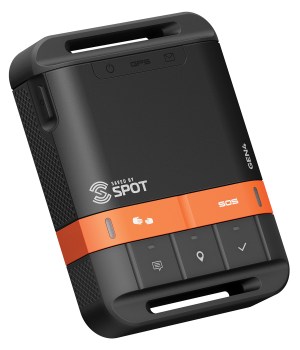 For sending messages from the wilderness to a party back in civilization, look into a one-way satellite messenger, like the SPOT GEN4 ($150, findmespot.com), with options that range from sending customized messages (you can program up to 1,250 messages) and your location to specific recipients to sending an SOS to the appropriate emergency-response team. Spot requires a service plan; prices start at $12/month. One drawback: It doesn’t receive messages. 5 oz.
TWO-WAY SATELLITE MESSENGERS
The most versatile messaging devices for the backcountry are two-way messengers, used primarily for multiday wilderness adventures. They provide the ability to share your location as well as exchange text messages with another party.
The BIVYSTICK ($350, bivy.com) is a smart little device that’s half the weight of a smartphone and, when paired with a phone, provides two-way texting via satellite to phone numbers or email addresses. Features include location sharing and tracking, SOS signaling with Global Rescue and preset check-in messaging. Downside: It isn’t cheap and requires a data plan (purchased separately, $18 to $50/month). 3.5 oz.
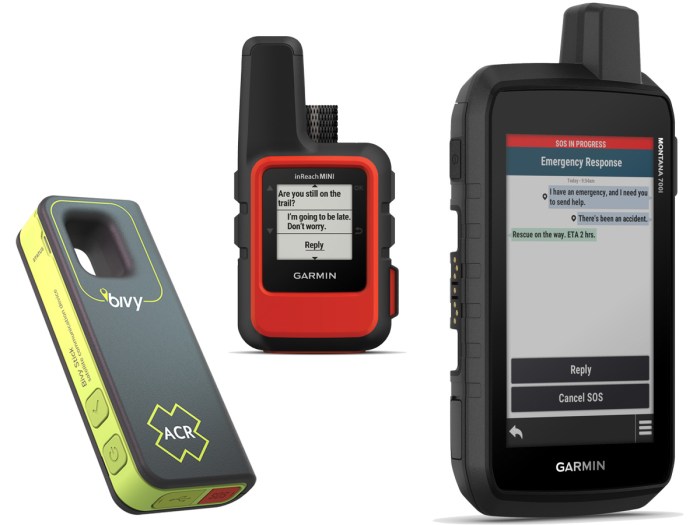
The popular, compact and lightweight GARMIN INREACH MINI ($350, garmin.com) sends messages either directly or with a paired cellphone, and allows texting back and forth. The GARMIN MONTANA 700I ($700, garmin.com) expands the backcountry tool kit with GPS functionality and a 5-inch display and keyboard for typing messages more easily. Garmin’s annual plans start at $12/month. 3.5 oz.
These are really great ideas about two way backcountry communication devices. Two other means of two way communications are the following techniques: Helium filled balloon with postage affixed to postcard contained in plastic ziplock bag attached to Helium balloon. If let go to rise into the sky at Philmont Scout Ranch located in Cimarron, State of New Mexico and let the balloon travel on the Westerly Breezes and Winds blowing to the East, the postcard and balloon will be received by the Sherrif Department’s Patrol Car Law Enforcement Team located in Tennessee (East of the Mississippi River in about seven (7) months…Two-Hundred Ten (210 days) days from the date that the postcard and balloon was let go airborne into the sky………Another two way back country communication is to write a message on two pieces of lined notebook paper and curl them into a bedroll and placed in a twenty fluid ounces (20 fl. oz.) plastic Coca Cola bottle complete with screw top lid and placed in a river flowing downstream from Philmont Scout Ranch located in Cimarron, State of New Mexico and flowing downstream to the Rio Grande River or flowing downstream to the Pacific Ocean. The plastic bottle (“Message in a bottle”) will be received by the Sherrif Department patrol car of the State of Texas or by the Sherrif Department patrol car of the State of California (whichever direction flowing downstream travels toward the Rio Grande River or the Pacific Ocean in about eight (8) months depending on downstream water flow from Philmont Scout Ranch located in Cimarron, State of New Mexico. These are really great ideas.
I’m good
I use Motarola talkies (21 miles)
“talkies” are not good in an emergency situation as you will only be talking to people in your group that already are there with you.
“Direct call” and “Privacy” does not mean the communication is scrambled.
or you could get your ham ticket for $15 and a cheap radio for longer communications
I am going to get one right now! I rated this 5 stars! Hope you like this coment
Asking for the Midland GTX1000VP4 for Christmas. Features include but are not limited to: up to36 mile range
SOS locator beacon
VOX operable, 9 levels of sensitivity
FRS/GMR, 50 channels
LO/MED/HI power settings
NOAA Weather Scan and Hazard Alert
Thing is, do you really need 20+ miles? Save your money if you don`t.
Thing is, when you really need 20+ mile range and dont have it (like in an emergency)…. what happens then? Just sayin
I use Motorola CT250 UHF radios, can be found for about 150/radio online. Have them on the UHF MURS (Multi User Radio Service, also license free) and no one on those little “bubble pack” radios as they are called can intercept your communications. Also my troop has me, a ham radio operator, to provide emergency communications should something happen.
73’s
I’m getting into ham radio, and I was just wondering what is the best help for the test.
Just picked up a set of 6 Cobra Micro radios; impressive. They have a 28 mile range and are all tuned alike. we will have 1 radio for each pair of scouts in case we get separated or spread out. I also bought the matching solar charger. * With its long range they’ll also work great for vehicle communicating while traveling cross-country in 3 vehicles.
i need one of those!
Me, and my brothers all have Midland radios they have 15 calls the really good ones do and you can talk to someone else on the same channel even if theirs are not Midland. They also have a vibrate setting and hedsets about supposedly 20 mi allclear hands free too
they are good
where do i find a good (and cheap) 4 way walkie talkie
no such thing trust me
Dude, look at Bass Pro Shops selection because they are good and sort of cheap. also, for 4 way talking, simply buy several of the same radio set, making sure that they’re on the same channel at ALL times.
You could use ham radio